


If you have been comparing EVs and hybrids in Utah, you have probably noticed that the choice is not just about gas savings. Drivers here deal with winter inversions, snowy commutes, steep canyon roads, freezing temperatures, and long stretches between towns. That makes the EV vs hybrid decision more local than it might be in other states.
Along the Wasatch Front, zero-tailpipe-emission driving can be especially appealing because winter inversions trap pollution near the ground. But for drivers who often head into the mountains, visit Southern Utah, or travel through rural areas, charging access and winter range still matter.
Let’s walk through the pros and cons of EVs, hybrids, and plug-in hybrids so you can choose the option that fits your daily driving in Utah.
EV vs Hybrid vs Plug-in Hybrid: Basic Differences
An electric vehicle, or EV, runs only on battery power. It must be charged at home, work, or a public charging station.
A traditional hybrid, or HEV, uses a gasoline engine and an electric motor. The battery charges itself through driving and regenerative braking, so the driver never plugs it in.
A plug-in hybrid, or PHEV, has a larger battery than a traditional hybrid. It can drive short distances on electricity, then switch to gasoline when the battery is depleted.
Not sure which type fits your lifestyle? Explore available inventory to compare real models side by side.
Pros of Driving an EV in Utah
1. EVs help reduce tailpipe emissions during inversion season
This is one of the strongest Utah-specific reasons to consider an EV. Winter inversions are common in Utah’s valleys because cold air and pollution can get trapped under warmer air above. The Utah DEQ identifies Utah’s geography as a major reason pollutants build up during inversion events.
EVs do not produce tailpipe emissions while driving. For commuters in Salt Lake County, Utah County, Davis County, Weber County, and other Wasatch Front areas, that matters because daily vehicle emissions contribute to local air-quality problems.
2. Home charging can make daily driving cheaper
EVs are most practical when the driver can charge at home overnight. For a daily commuter, this means starting most mornings with a full battery instead of stopping at a gas station.
The biggest savings usually come from home charging, not public fast charging. Public DC fast chargers are useful for road trips, but home charging is usually the more convenient and cost-effective daily setup.
3. EVs perform well on Utah canyon roads
EVs deliver instant torque. That helps when climbing steep roads such as Parleys Canyon, Big Cottonwood Canyon, Little Cottonwood Canyon, or roads leading to Park City and ski resorts.
Unlike gas engines, electric motors do not lose power because of elevation in the same way naturally aspirated combustion engines can. That makes EV acceleration feel strong and consistent in mountain driving.
4. Regenerative braking helps on descents
EVs can recover energy when slowing down through regenerative braking. This is useful after climbing Utah canyon roads because the vehicle can regain some energy while descending.
Regenerative braking does not eliminate the energy cost of mountain driving, but it improves efficiency compared with wasting all braking energy as heat.
5. EVs usually require less routine maintenance
EVs do not need oil changes, spark plugs, exhaust repairs, timing belts, or many other gas-engine services. They still need tires, brakes, cabin filters, coolant checks, and battery-system inspections, but their routine maintenance list is shorter than a hybrid’s.
6. Some Utah buyers may qualify for EV assistance
Utah’s Electric Vehicle Replacement Assistance Program, or EVRAP, is designed to help income-qualified residents replace older gas or diesel vehicles with electric vehicles. Utah DEQ describes EVRAP as an income-qualified program for replacing older, higher-polluting vehicles with new or used EVs.
Some local health departments list assistance amounts up to $10,000 depending on income. Weber-Morgan Health Department, for example, lists up to $10,000 for applicants at or below 300% of the federal poverty line, up to $7,000 for 301% to 400%, and up to $4,000 for 401% to 500%.
Cons of Driving an EV in Utah
1. Cold weather reduces EV range
Utah winters can reduce EV range, especially during freezing temperatures, snowstorms, and ski-season travel. AAA’s 2026 testing found that extreme temperatures reduce efficiency, range, and operating costs for both EVs and hybrids, with cold weather being especially important for EV range planning.
Real-world EV winter range loss varies by model, battery size, heat pump, speed, tires, elevation, and heater use. Recurrent’s winter EV range analysis notes that all vehicles lose efficiency in very cold weather and that EV range loss is temporary but still important for planning.
2. EV ownership is harder without home charging
An EV is easiest to own when you have a garage, driveway, or dedicated parking space with charging access. It is less convenient for renters, apartment residents, students, and drivers who rely only on public charging.
A Level 2 home charger is not required for every EV owner, but it makes daily use much easier. The federal Alternative Fuel Vehicle Refueling Property Credit can cover 30% of eligible home charging equipment costs up to $1,000 per item for qualifying property placed in service at a main home from January 1, 2023, through June 30, 2026.
3. Rural Utah still requires route planning
Utah’s charging network is improving, but remote travel still needs planning. UDOT announced NEVI-funded fast-charging sites intended to make EV travel easier along Utah interstates and key highways, including I-15, I-70, I-80, US-6, and US-191.
Utah Clean Cities says the statewide EV charging plan aims to ensure access to DC fast charging at least every 50 miles along Utah’s interstate highways and other key highways.
That helps major routes, but it does not mean every trailhead, remote state park, rural town, or backcountry route has easy charging. Trips to areas around the San Rafael Swell, Bears Ears, remote canyon country, or less-traveled parts of eastern Utah may still require careful planning.
4. EV road trips take longer than gas stops
EV road trips are very possible in Utah, especially in newer long-range models. The tradeoff is that charging stops usually take longer than filling a gas tank.
For planned routes such as Salt Lake City to Moab or Provo to St. George, an EV can work well. For spontaneous detours, winter storms, trailer towing, or remote recreation, a hybrid is often simpler.
5. Utah EV registration fees are higher
Utah charges alternative fuel vehicle fees to help fund road maintenance. Utah’s DMV explains that alternative-fuel owners can either join the Road Usage Charge program or pay a flat fee at registration.
For 2026, Utah’s Road Usage Charge site lists the EV flat-fee cap at $180 and the mileage-based rate at 1.25 cents per mile, capped at the flat fee.
Cache County’s DMV fee page lists 2026 alternative fuel fees as $180 for electric or other alternative fuel vehicles, $25 for hybrid electric vehicles, and $64 for plug-in hybrid electric vehicles.
Pros of Driving a Hybrid in Utah
1. Hybrids do not need charging
A traditional hybrid is easy to own because it uses regular gas stations. There is no charger installation, no apartment charging issue, and no need to plan daily life around plugs.
This makes hybrids especially practical for renters, college students, apartment residents, and anyone without dedicated parking.
2. Hybrids are convenient for long Utah road trips
A hybrid is easier than an EV for long trips across rural Utah. You can drive from Logan to St. George, Salt Lake City to Moab, Provo to Bryce Canyon, or Ogden to Capitol Reef without relying on a charging map.
Gas stations are faster and more widely available than DC fast chargers, especially away from major corridors.
3. Hybrids have a more predictable winter range
Hybrids can still lose fuel economy in winter, but they do not depend entirely on a large battery for driving range. Their gas engines also generate cabin heat naturally.
For Utah drivers who regularly travel in freezing temperatures, park outside, or make long ski trips, a hybrid can feel less stressful than a full EV.
4. Hybrids are efficient in stop-and-go traffic
Hybrids are strongest in city and suburban driving. Their electric motors help at low speeds, during stop-and-go traffic, and while idling.
That makes them useful for I-15 congestion, Salt Lake City commuting, school drop-offs, errands, and daily driving in Provo, Sandy, Lehi, Ogden, and surrounding areas.
5. Hybrids currently have a strong reliability record
Consumer Reports’ recent reliability coverage says hybrids remain among the most reliable vehicle types, while EVs and plug-in hybrids have improved but still tend to have more issues on average than conventional gas vehicles or standard hybrids.
This does not mean every hybrid is reliable or every EV is unreliable. Model choice still matters. But for shoppers prioritizing proven long-term reliability, traditional hybrids have a strong case.
6. Hybrid registration fees are lower than EV fees in Utah
Utah’s alternative fuel fees are lower for traditional hybrids than for EVs. Cache County’s DMV page lists 2026 fees of $25 for hybrid electric vehicles, $64 for plug-in hybrid electric vehicles, and $180 for electric or other alternative fuel vehicles.
Cons of Driving a Hybrid in Utah
1. Hybrids still produce tailpipe emissions
A hybrid burns gasoline. Even if it uses less fuel than a traditional gas vehicle, it still contributes to tailpipe emissions.
For Wasatch Front drivers concerned about inversion-season pollution, this is the biggest drawback compared with an EV.
2. Hybrids still need gas-engine maintenance
Hybrids have electric components, but they also keep the gas engine. That means oil changes, spark plugs, engine air filters, exhaust components, emissions systems, and possible catalytic converter repairs.
A hybrid may use less fuel, but it is not as mechanically simple as an EV.
3. Some hybrids feel strained on steep climbs
Many hybrids are tuned for fuel economy, not power. On steep canyon roads, a smaller hybrid engine may rev loudly and feel less relaxed than an EV with instant torque.
This does not make hybrids bad for mountain driving. It means buyers should test-drive the specific model on hills if they regularly drive to ski resorts, mountain neighborhoods, or high-elevation routes.
4. Highway savings may be smaller than city savings
Hybrids usually deliver their best fuel economy in city driving. At high freeway speeds, the efficiency advantage can shrink because the gas engine is doing more of the work.
For a Utah driver who spends most of their time on long, high-speed routes, the difference between a hybrid and an efficient gas vehicle may be smaller than expected.
5. Plug-in hybrids add complexity
A PHEV can be the best middle ground, but it is also more complex than a standard hybrid. It has a gas engine, an electric motor, a larger battery, charging hardware, and more operating modes.
Consumer Reports has found that plug-in hybrids have had more reliability issues than standard hybrids on average, although individual models vary.
Is a Plug-in Hybrid the Best Option for Utah?
A plug-in hybrid can be the best compromise for many Utah drivers.
A PHEV works well if you drive short distances during the week, can charge at home, and still want a gas engine for Moab, Zion, Bryce Canyon, Capitol Reef, Lake Powell, ski trips, and rural routes.
The main rule is simple: a PHEV only makes sense if you plug it in regularly. If you do not charge it, you are carrying extra battery weight without getting the full benefit.
Choose a PHEV if you want EV-like commuting and hybrid-like road-trip flexibility.
Which Should You Choose?
Final Verdict
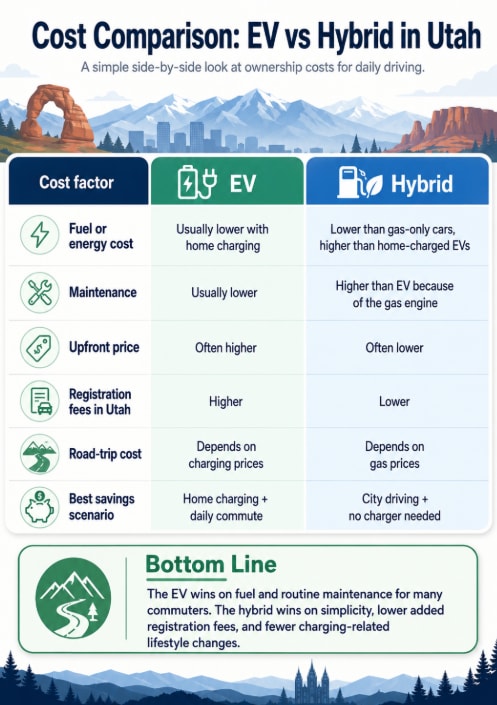
For daily driving in Utah, an EV is the better choice for homeowners with reliable charging, predictable commutes, and a desire to cut tailpipe emissions during inversion season. It is especially strong for Salt Lake City, Provo, Ogden, Lehi, Sandy, and other Wasatch Front commuters who can charge overnight.
A hybrid is the better choice for renters, road-trippers, rural drivers, and anyone who wants winter-range consistency without the charging logistics. It is the simpler option for frequent trips to Southern Utah, ski areas, national parks, and remote recreation spots.
A plug-in hybrid is the middle ground. It gives Utah drivers electric commuting during the week and gasoline flexibility for weekend travel.
FAQs on EV vs Hybrid in Utah
1. Which is better for Utah, EV or hybrid?
An EV is better for Utah drivers who can charge at home and mostly commute along the Wasatch Front. A hybrid is better for drivers who lack home charging, travel long distances, or frequently visit rural Utah.
2. Are EVs good for Utah winters?
Yes, EVs can be good for Utah winters, but drivers should expect reduced range in cold weather. AAA’s 2026 testing found that extreme temperatures reduce vehicle efficiency and range, and Recurrent’s winter analysis notes that cold-weather EV range loss is temporary but important to plan around.
3. Are hybrids better than EVs for road trips?
For most Utah road trips, hybrids are more convenient because they refuel quickly at gas stations. EVs can handle many Utah road trips, but they require more planning around charging locations and charging time.
4. Do EVs help with Utah inversions?
EVs help reduce tailpipe emissions because they do not emit exhaust while driving. Utah DEQ explains that inversions trap pollution near the ground, which makes local emissions an important air-quality issue during winter.
5. Are hybrids more reliable than EVs?
Consumer Reports’ recent reliability findings favor traditional hybrids overall, while EVs and plug-in hybrids have improved but still tend to show more issues on average.