


Buying an electric car often starts with one important question: How far can it actually go on a full charge? The range listed by the manufacturer can look impressive, but real-world driving may tell a different story. Cold weather, highway speeds, heavy cargo, traffic, and even your driving habits can affect how many miles you get from a charge.
Understanding these electric car range factors before buying an EV can help you avoid range anxiety and choose a vehicle that fits your daily commute, road trips, and charging routine. Instead of relying only on the number shown on the window sticker, it is important to know what can increase or reduce your EV's actual driving range.
What Determines Electric Car Range?
Range is the result of how much usable energy the battery stores and how much energy the vehicle consumes while driving. Everything from temperature to road conditions can change that energy consumption.
The main electric car range factors include:
-
Battery capacity and chemistry: Determines how much energy the vehicle can store and deliver.
-
Weather and temperature: Extreme temperatures can increase energy use.
-
Driving style and speed: Aggressive acceleration and sustained highway speeds consume more energy.
-
Terrain and vehicle weight: Hills, passengers, cargo, and towing increase the workload on the vehicle.
-
Charging habits: Battery use and charging patterns can influence long-term battery capacity.
No single factor determines range. Instead, these factors work together to determine how far an EV can travel between charges.
How Battery Size and Chemistry Affect Range
Battery size, measured in kilowatt-hours (kWh), is one of the first specifications buyers look at when comparing EVs. A larger battery can store more energy, but battery capacity alone does not determine how far a vehicle can travel.
Two EVs with similar battery sizes can have different ranges because of differences in vehicle weight, motor efficiency, aerodynamics, battery chemistry, and energy management systems.
Battery chemistry also plays a role. Many EVs use lithium-ion battery technology, with common chemistries including nickel-based NMC/NCA batteries and lithium iron phosphate (LFP) batteries. Each technology has different characteristics related to energy density, charging behavior, durability, and cost.
For buyers, the important point is simple: do not compare battery size alone. Look at the vehicle's rated range and consider how efficiently it uses the stored energy.
How Weather and Temperature Change Real-World Range
Temperature is one of the most noticeable short-term factors affecting EV range. Both very cold and very hot conditions can increase energy consumption because the vehicle may need additional power for battery temperature management and cabin heating or cooling.
For buyers who live in areas with cold winters, this difference is important to consider. An EV that works well for a daily commute in mild weather may require more frequent charging when temperatures drop.
One useful strategy is preconditioning the vehicle while it is still plugged in. This allows the vehicle to use electricity from the charging source to prepare the cabin rather than drawing as much energy from the battery after you begin driving.
How Driving Style and Speed Affect EV Range
Your driving habits can also influence EV driving range. Like any vehicle, an EV consumes more energy when it is driven aggressively.
Several driving-related factors can affect range:
-
Speed: Higher speeds increase aerodynamic drag and can reduce efficiency.
-
Acceleration: Frequent hard acceleration requires more energy than smooth acceleration.
-
Braking: Regenerative braking can recover some energy during deceleration.
-
Traffic: Frequent acceleration and braking can change energy consumption depending on driving conditions.
-
Route planning: Choosing a steady and efficient route can help reduce unnecessary energy use.
Highway driving deserves particular attention. At higher speeds, aerodynamic resistance increases substantially, meaning an EV may consume more energy per mile than it does during slower urban driving.
If most of your driving consists of long highway trips, consider your typical highway speed and driving conditions when evaluating an EV's advertised range.
How Terrain, Weight, and Aerodynamics Play a Role
The road you drive on and what you carry in your vehicle can also change range.
For example, an EV that normally handles a daily commute comfortably may use more energy when carrying several passengers, climbing steep roads, or towing a trailer.
This is especially important if you regularly take road trips, transport large amounts of equipment, or use a roof rack.
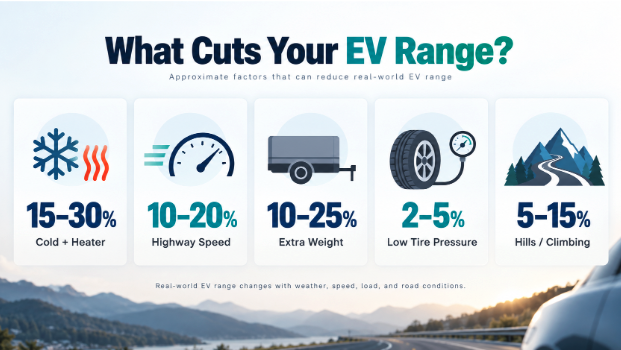
These real-world conditions can reduce EV range in different ways. The infographic below highlights some of the most common factors that can cut the distance you get from a charge.
Charging Habits and Long-Term Range
Range is not only a day-one consideration. EV batteries gradually lose some capacity as they age, which means the maximum range available from a full charge can decrease over time.
Battery degradation varies based on factors such as battery design, climate, mileage, charging behavior, and vehicle use. Frequent high-power charging and prolonged exposure to extreme temperatures can affect battery health, although modern EV battery management systems are designed to help protect the battery.
For everyday driving, following the manufacturer's charging recommendations is a practical approach.
If you are evaluating a used EV, battery condition becomes particularly important. Instead of looking only at the original advertised range, check the vehicle's current battery condition, mileage, charging history when available, and remaining battery warranty.
When comparing available vehicles, you can explore Axio EV's pre-owned vehicle inventory to see current used EV options and their listed electric range.
EPA Ratings vs. Real-World Range: Why They Differ
Official EV range ratings are useful because they provide a standardized way to compare vehicles. However, they are not a guarantee of the exact number of miles every driver will achieve.
Your actual range can differ because of:
-
Temperature
-
Driving speed
-
Driving style
-
Passenger and cargo weight
-
Use of heating or air conditioning
-
Road and traffic conditions
-
Tire pressure
-
Terrain
This is why it is better to treat the official range as a comparison figure rather than a promise of your exact real-world range.
When comparing vehicles, look at the official range and then consider how your own driving conditions differ from the conditions used for testing.
For additional information about official fuel economy and vehicle efficiency ratings, visit FuelEconomy.gov, the U.S. Department of Energy's consumer resource.
How to Estimate the Range You'll Actually Need
Instead of choosing an EV simply because it has the highest advertised range, start with your own driving habits.
1. Track Your Typical Daily Driving
Look at how many miles you normally drive for work, school, errands, and other regular activities.
2. Consider Your Local Climate
If you regularly experience very cold or hot weather, allow additional range for temperature-related energy use.
3. Think About Your Charging Access
A shorter-range EV with convenient overnight home charging may be more practical for your lifestyle than a longer-range EV without reliable charging access.
4. Consider Your Longest Regular Trip
Think beyond your average commute. If you regularly drive several hundred miles, check where charging stations are located along your usual routes.
5. Leave a Comfortable Buffer
Avoid planning every trip around the vehicle's maximum advertised range. Keeping some additional range available gives you more flexibility when traffic, weather, detours, or unexpected stops change your plans.
Range Factors Checklist Before You Buy
Before choosing an EV, consider:
-
Compare the official range with your typical driving conditions.
-
Consider how winter or summer temperatures may affect range.
-
Check battery capacity and battery technology.
-
Look at your access to home or workplace charging.
-
Consider your typical highway driving.
-
Factor in passengers and cargo.
-
Consider towing or roof-rack use if relevant to your lifestyle.
-
Check the manufacturer's battery warranty.
-
If buying used, investigate battery condition and remaining warranty.
-
Leave a practical range buffer for daily driving.
Final Thoughts
Electric car range factors go well beyond the number shown on a vehicle's window sticker. Battery capacity, weather, speed, driving habits, terrain, vehicle weight, and charging conditions can all affect how far an EV travels on a charge.
Understanding these factors before buying helps you set realistic expectations and compare vehicles based on how you actually drive. When you consider your daily mileage, climate, charging access, and longest regular trips, it becomes easier to determine how much EV range you really need.
Frequently Asked Questions
1. What are the main electric car range factors?
The main factors include battery capacity, temperature, driving speed, driving style, terrain, vehicle weight, aerodynamics, tire pressure, climate-control use, and battery condition.
2. How much can cold weather reduce EV range?
Cold weather can have a significant effect on EV range. AAA's 2026 testing found an average 39% decrease in driving range at 20°F compared with the 75°F baseline, although results varied by vehicle.
3. Does highway driving reduce EV range?
Highway driving can reduce EV efficiency because aerodynamic drag increases as speed rises. Sustained high-speed driving generally uses more energy per mile than slower driving.
4. Does battery size determine EV range?
Battery size is important, but it is not the only factor. Vehicle weight, aerodynamics, motor efficiency, battery chemistry, software, and driving conditions also influence range.
5. Should I buy an EV with the highest possible range?
Not necessarily. The right range depends on your daily mileage, longest regular trips, climate, and access to charging. A vehicle with a range that comfortably covers your normal driving may be more practical than simply choosing the highest available range.
Categories:
Social